
A Surrealist Journey Through Time
A review of the short film Untitled, directed by Andrew Culver

The short film Untitled, directed by Andrew Culver, is one of those works built around a single, original central idea that carries it forward from the very first moment. In the opening scene, two young men sit in a house; it is rightly emphasized that their heads are a little warm from drinking beer when one of them introduces the film’s idea in the form of a story that happened to him a few weeks earlier. He had gone to see a film that had no title. A film without a name after watching which it was impossible to look it up on the internet, or to find any trace of it at all.

Short films can offer precious and valuable opportunities for a filmmaker to think freely and without the usual constraints of commercial cinema, to express the idea they have in mind, and to bring what is in their head to the screen. The more abstract, unusual, and different the idea, the more striking and distinctive the result can be. The best space for developing an abstract and unconventional thought is precisely the short film—where one can move freely and comfortably in whatever direction creativity leads. Andrew Culver clearly understood how such an idea—a film without a title—needed to be presented for the audience to believe it: as a memory that one of the partygoers, especially after a few beers, is recounting to the others. At the same time that one can suspect he is lying or is simply under the influence, one can also believe him and begin to consider the possibilities of such an idea.

At this party consisting of young people, it seems that besides these two friends, others are also listening to the strange story of seeing a film with no name. The young man who has been sitting silently to the side the whole time—Nick—suddenly enters the conversation and comments on the nature of that film, whether it was a comedy or a horror. The strength of Andrew Culver’s work is that he does not stop at the original idea; he expands it through the other characters. The expansion of that initial thought occurs when Nick insists the film could not have been a comedy, even if the person telling the story felt it was. The filmmaker intelligently moves away from remaining stuck in the original idea and turns to other subjects that pass through the minds of the other characters. As a result, one can see that a great deal of attention has been paid to characterization. The filmmaker knew that a special idea alone is not enough to make an engaging film; like a crystal ball that can be turned and viewed from different angles, the different facets of that idea must be explored through the perspectives of different characters.

The things Nick says open a new dimension to the story of seeing a film without a title. Looking a little depressed, staring at an indeterminate point as if speaking to himself, he talks about how the hero of every story needs to overcome an obstacle—yet this is not a reflection of reality. He speaks of that vague human desire to be inside a more exciting and interesting story than reality itself. This fantasy, in his view, is meant to give human life a little meaning. While he is talking about these abstract ideas, we see the other two looking at him as if he is talking nonsense. Here the filmmaker cleverly reflects the reaction one would expect the audience to have toward these words. In doing so, the filmmaker preemptively acknowledges the strangeness of these remarks, and precisely because of that, makes them more believable. In a simple conversation among teenagers, the filmmaker shows both the funny, comic side of an unusual situation (seeing a film without a title) and goes beyond it to share its dark and somber dimension with us.

Filmmakers who succeed in the short-film form are generally skilled at one thing and share that one quality. They may reach it through different methods—one through a crowded space with many characters in a comic style, another through a sparse, dialogue-driven film, another through silence and music, and so on—but what they all have in common is arriving at a world that is presented from multiple angles, that has several dimensions, that is not single-axis or single-meaning, and that, like life itself, has many aspects. Culver’s art is that in a simple, ordinary conversation at a teenage party, through a subject that at first seems trivial, he achieves exactly this. It is a discussion between someone who only points to the fun and light side of a film without a hero, and someone who has in mind the meaninglessness of existence and of being human.
The words of that apparently depressed young man go beyond the boundaries of the subject at hand (seeing a film without a title) and reach far more important and universal subjects: among them, the meaninglessness of human effort to give meaning to a life that is inherently without concept or meaning; why we are alive; what we are doing on this earth; what all these everyday actions mean; what the purpose of doing all these things is. And finally it arrives at the subject that has always preoccupied the human mind: death.

Suddenly the party space and the people present in it disappear, and only the young man remains, together with the messenger of death, or the Angel of Death, standing waiting on the threshold of the door. The filmmaker skillfully and effortlessly changes the mood and transforms the atmosphere. The shift from ordinary reality to a melancholic, unusual, even surrealist space is in fact like a movement from the outside to the inside, from the collective environment into the individual’s mind—from objectivity to subjectivity.

Andrew Culver’s art lies in beginning in a cheerful, light-hearted atmosphere among the people at the party and introducing characters who lead us to believe that the one telling the story is the main character of the film—only for that impression to change before long, so that we accompany the young man who from the beginning had been sitting silently in the corner of the frame. The movement between subjects, the movement between comic and frightening tones, the movement between outside and inside—these are the trump cards of this film’s director. Notice the nightmarish space the young man experiences. Still inside the closed space of the house, he moves from the living room toward the other rooms; we guess he goes upstairs, and there he not only encounters strings of decorative lights but, in a red room, comes face to face with a woman he does not know at all.

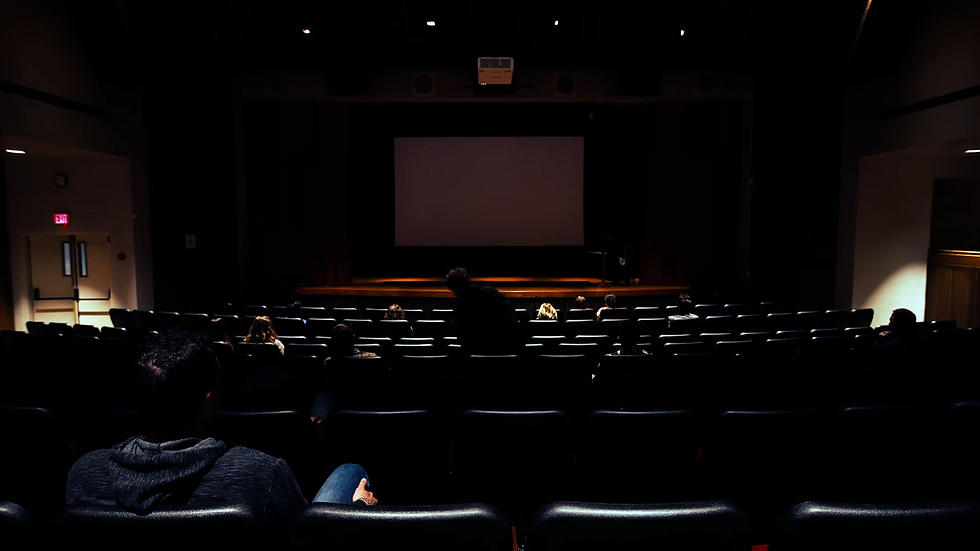
The spatial changes in the film are not limited to Nick’s nightmare; they go further and reach the subject of dying itself. Upstairs in the red room, Nick realizes that he is dead and must now come to terms with his own death—while no one is going to remember his name or his performance (or his acting in this film). With another shift of space, we become certain we are dealing with a surrealist film that intends to translate its character’s inner and mental journey through strange images and places. Nick goes to a cinema where, in a bizarre space, people are waiting for the screening to begin.

The final third of the film is brilliant and distinguished in its own right. The film ends by returning to its starting point—but how? In that strange cinema, Nick sits down to watch a film. A film that is familiar to us. In this film we see him saying the same things he said in the opening scene about hope and the meaninglessness of living and so on to his friends—with the difference that from this angle he is alone, and only the specter of death is standing in the room. The people in the cinema laugh at the serious and bitter words of the “Nick” on the screen, just as the friend at the party had said, and interestingly that same friend is also sitting in the cinema. Therefore Nick, in a journey into the past, or in the recollection of an event at which he was present, has traveled into that memory. The intermingling of time, and movement through time, adds more complex dimensions to this surrealist film. Had Nick already been present in that cinema and, together with that young man, been watching a film about the present moment? One can therefore guess that this circle will continue forever and that we will never know whether the film of those words existed first or the party, and we guess that Nick is condemned to repeat those party conversations for eternity. On another level we realize that the person who spoke about his experience of the nameless film was not wrong: the audience in that hall really were laughing at the film.
Andrew Culver has made a film that challenges reality and fantasy, challenges real time and elapsed time, and ultimately plays a complex game with the concept of readiness to accept death and the threatening shadow of death over human life. The short film Untitled is a captivating and engaging short film that, with its limited means and locations, points to really important concepts and arrives at a form of surrealism that is in its own way artistic and creative. The film brings in concepts such as death, the meaninglessness of human actions, and finally the attempt to become a hero in a more exciting film (that is, the natural human desire to escape boredom), and offers us an opportunity to think about all of these ideas.


Glad you enjoyed the film! Sorry my acting was so bad ;(