
The Eternal Cycle of Master and Slave
A review of the short film Who’s Choreographing Us?, directed by BUSE BASKI and Georgia Bloom
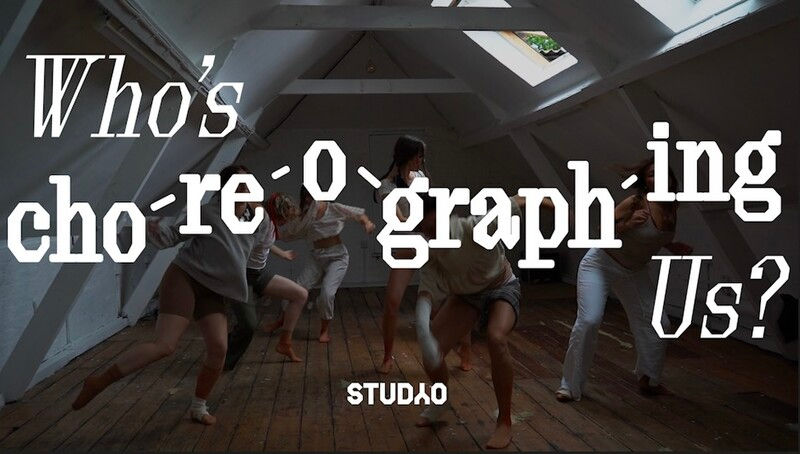
Films that use dance as their primary mode of expression generally fall into two categories. The first group is known as screendance: films in which the choreography is specifically designed for the camera, and through the possibilities that cinematic tools offer the makers—lenses, frames, horizontal and vertical camera movements, editing, and so on—we are meant to arrive at a different understanding of watching dance. The second group is called Dance Movies: films in which the main characters, while advancing a narrative line, are also dancers, and through dance they help propel that narrative forward. In Who’s Choreographing Us? we encounter a brilliant and extraordinary example of the combination of both these groups—yet not merely a combination of the two, but a going beyond them and the arrival at a third form, a third group in which we are meant to confront something different.

The directors, BUSE BASKI and Georgia Bloom, knew very well that they were not going to make a straightforward or simple work, and from the outset they decided to select their audience from among the attentive and cinema-literate public. Choosing one’s audience, and defining the group of viewers, is always a great help to the filmmaker. BUSE BASKI and Georgia Bloom understood that if they were to make a film for all cinema spectators in which dance was the principal and most important method of conveying concepts, they would be forced to take into account the understanding and reception of less experienced viewers who are less familiar with cinematic matters, and consequently to make something simpler and more accessible. But they preferred to target an audience that is acquainted with cinematic genres, that knows the various kinds of film and categories such as text and subtext, that is familiar with cinematic movements and schools, and—most importantly—that is fully prepared to accept experimentalism in a cinematic work. In Who’s Choreographing Us? we are faced with a highly experimental film that shares deep and complex concepts with its viewer in a multilayered and demanding way. For this reason, choosing the short film as the medium was the best possible decision. The spectator has the opportunity, by watching the film a second and third time, to strive toward understanding its meanings.

The film begins in an attic room. Seven dancers are in this room, and the natural light of day streams in through the windows. We are therefore confronted with a kind of Stage. The filmmakers knew that this scene had to both evoke a theatrical stage and be accepted as an ordinary location of everyday life. It seems that the reason for choosing this room was to create a kind of connection with realism. Although we are dealing with an Experimental film, an important feature of it is the relationship it maintains with Realism, and the sign of this realism is the choice of location.
The energetic music and its highly kinetic rhythm draw us into the world of the work from the very beginning, and because of the type of instrumentation—especially the sound of the saxophone—a kind of madness is injected into the film. A madness that immediately appears in the dancers’ movement once they begin to dance. Thus the music and the type of movements are aligned in showing one single thing. What is that thing? Mere uproar? Chaos? Or something beyond? By looking at the dancers’ movement patterns and paying attention to the details of how individuals shift position on this Stage, by following the path of each one’s movement and observing the result of the paired and tripled movements of the individuals, we discover that this scene, this dance, is in fact intended to be a symbol of a social condition. In the first movement, the person standing in the middle of the room, by giving orders through the movement of their hand, forces the others to sit or to rise in turn and at their will. But a fissure appears in this authoritative leading, in such a way that in the next movement (when the individuals are standing in a train-like line), the person at the beginning of the chain forces the others to act in a certain way.

The woman who is engaged in leading is worshipped by her subordinates. Being worshipped is equivalent to the leader becoming blind. The multilayered complexity of this film becomes apparent here, as it shares its theme with us in an indirect manner. In the film it is clear how the person who is occupied with leading others, precisely because of being worshipped by their subordinates, is transformed into a blind and authoritative being. In this relationship, and as is evident in the film, there exists a complementary connection between master and subject, between leader and follower. When they raise their hand, everyone must raise their hand; when they turn their head, everyone must turn their head. In this unconditional obedience the individuals have no rights, and it is precisely these rightless individuals who worship their leader, and in one scene we even see them lifting them up on their shoulders.
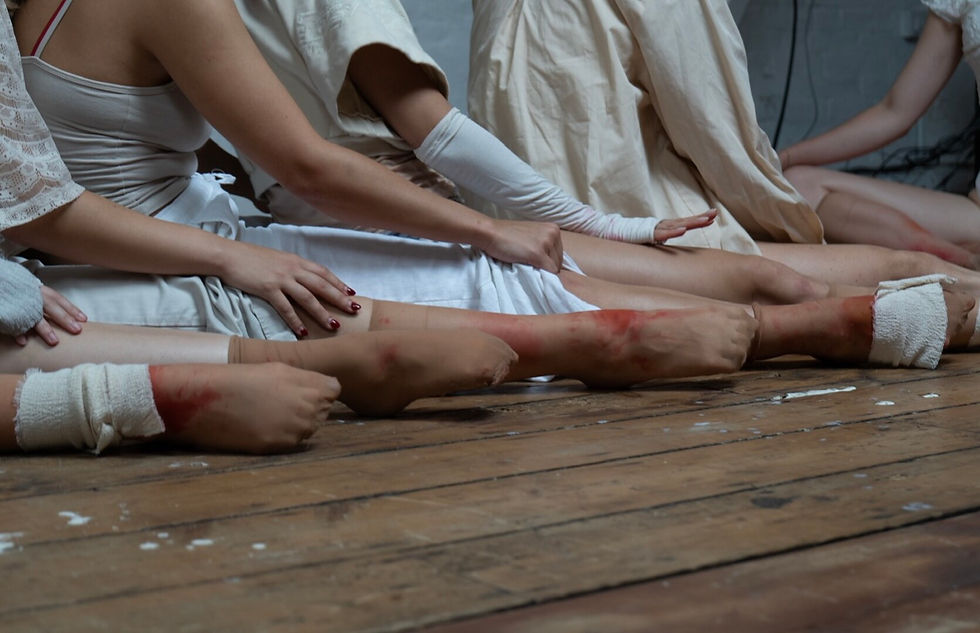
Suddenly, in the middle of the film, the leader changes. Now we are faced with a man who occupies the position of the previous leader, standing at the center of the circle and staring forward with firmness and seriousness. It is he around whom everyone gathers in a circle, and it is he who, when he walks, the others move after him in a slave-like manner. At the bottom of the image, through the filmmakers’ supplementary explanations, we read “Movement is orchestrated,” and in another scene we read “Control is absolute.” For someone who has attained power, having dominion over everything is important. Either everything or nothing. Either slave or sultan. Either obedient or leader. Either powerful or weak. In the world that the filmmakers depict, individuals for a while madly occupy themselves with the worship of someone and then set them aside completely, or even, together with the former leader who has now become one of the worshippers, begin to worship a new person. At the end of the film, in the third section, the leader changes once more and again a woman—a different woman from the first leader—takes leadership of the group. One can imagine that this cycle continues forever.

The directors have made excellent use of the available means—of the space and the dancers, and of course of the movements and the way they are designed—in order to express their intended meanings in a thoughtful experimental work, and they have succeeded very well in this task. While watching the work we say to ourselves that each of these gazes, each of these movements of hand and head and foot, each of these relationships constructed among the members of the performance, leads to the formation of a totality that expresses the film’s subject in the most precise way. Around this subject there are also smaller meanings that are well conveyed to us through the individuals’ behavior and the design of the dances. Among them are the relationship of the previous leader with the new leader, the way the followers look at the leader, and the suffering that we sometimes see in the faces and behavior of the persons as they obey the leader’s commands. In all of these we are confronted with a living and dynamic relationship. We are confronted with a relationship that continually changes shape and transforms, and in these transformations makes known to us the various aspects of a relationship.
The film depicts a condition that we encounter more and more in modern societies. Both in the relationship between governing power and the people, and especially in the relationship of ordinary people with one another, when they gather around a subject. One can imagine the residents of a building who have a relationship with the manager of that building and flatteringly praise him because they need him, and when the building manager changes they adopt the same behavior toward the new manager. A thousand other situations can be imagined that this condition symbolically represents and upon which it can be mapped.
Who’s Choreographing Us? is an artistic, subtle, and precise film that establishes a strong communicative skill with its spectator. The dances are well designed, the actors/dancers are well directed, and the cinematography serves the work.



Comments