
Making Art from Life: An Interview on Motherhood, Caregiving, and Independent Filmmaking - Eve Natasha Leonard-Walsh On 'Because We Are Too Many'
Updated: Aug 18

Please tell us a little about yourself. How did you become interested in cinema? Did you receive any formal filmmaking education, or did you start out as a self-taught filmmaker?
I taught myself to edit on an old version of Final Cut Pro and went on to study film. I became pregnant with my son while studying for a Masters in film directing, and have since been a full time mother and carer. My particular interest is in European cinema and Noir and I continue to write scripts. As I think in visuals, filmmaking and scriptwriting feel natural to me.
Tell us about your previous projects, before making Because We Are Too Many. Where did the idea for this film come from?
I became interested in filmmaking in my late twenties and began making short documentaries on issues such as homelessness. I wanted to merge fiction and documentary, and I leaned into this idea with Because We Are Too Many. Covid was obviously not in the original script, but I decided to work this into the narrative, as it felt particularly poignant for those experiencing isolation during this difficult time.
Your film opens with a quotation from Edgar Allan Poe. To what extent were you influenced by the atmosphere of his works while making this film?
My focus has always been on writing; and reading was my first love. The film also includes quotes by Robert Louis Stevenson and original artwork by Monk and Reizan Death Designer. The poem in the film was written by the actor himself (Henry Hilson Agbangbe) and his character is based on a poet friend of mine, who is from the Sudan. I like to think of film as collaborative and love to incorporate work by other artists.

The performances by you and your son in the film are remarkable. Could you tell us about the experience of directing and acting at the same time, and what it was like working with a young actor? What did you learn from this experience?
Though the casting of myself and my son was really done out of necessity rather than choice (we had no funding) I do think now that it was the right path. I don’t think I thought it through, but I was processing his diagnosis without realizing it, and the film has helped me to do that. I hope the film may let other carers know that they are seen and understood.
Eilidh Keane (young Morgan) and Anthony Bradley (Andy) were so great to work with and total professionals. I love working with children and animals and have no idea why they tell people not too?
The cinematography is particularly striking. How do you generally approach cinematography, do you give a cinematographer a certain degree of freedom, or do you plan every shot in detail?
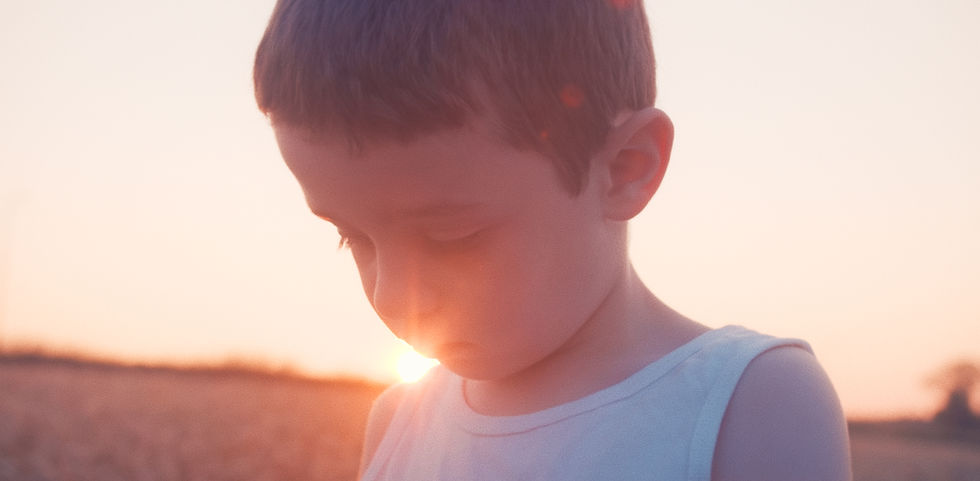
The shots are intentionally static and pared back, as this approach seemed the most appropriate to me, given the heavy subject matter. I like small enclosed spaces and tight close-ups, which is just a personal preference. My young DOP and I (he was 20 when we started filming) had never shot a feature film and we definitely made some mistakes, but it evolved and we learned together. He likes my ideas and supports them but he can also fight his own corner, so it just works! It was shot sporadically over 3 years, each time saving a little money for the next shoot. My son grew about a foot taller, so editing was challenging!

Could you tell us a little about the logic behind the different color tones used throughout the film? What was the reason for changing the color palette from one scene to another?
The color is de-saturated for the parts in the present day and heavily color saturated for the parts which are memories. Again, just a personal preference, as memory can feel so much richer than reality.
Given that you are the writer, director, and producer of the film, how closely do you follow the script during production? Do you leave room for improvisation?
I had planned to use allot of improvisation but due to money constraints we had little to no time to rehearse, so ended up sticking mostly to the script. This is something I do want to explore with my next project though, when I have the luxury of time and being able to give my actors the support they need. Some scenes were shot in just an hour!
What was the most difficult part of making this film, and what aspects of the process did you feel could have been improved? Tell us about some of the challenges during production and post-production, please.
It is definitely safe to say that directing/producing while having full time care of a profoundly autistic small child is not recommended! It really was hell. It also meant that each scene that included him had to be shot documentary style as Ronin was unable to do repeated shots. But as it was shot over a few years, each shoot only lasting a few hours and far apart, it meant that I could edit as I went along with the project, the editing is as much a creative process as directing and writing, so the flow of the film possibly works better because it was shot like this. It is quite heartbreaking as a director to not be able to have it the way you want because you have no money, but it does give a certain amount of creative freedom.

Making a feature film, particularly one dealing with autistic children, is a very difficult task, especially when it comes to avoiding repetition and clichés. Could you tell us what strategies you employed to distance the film from familiar conventions and avoid clichés?
The film is really told from the perspective of a Carer not a person with autism. It might be patronizing to say that I understand how he experiences life, as I really don’t. Perhaps one day my son can tell that story.
Your film deals with profound psychological subjects. To what extent did you consult psychologists while developing the screenplay? Or, more generally, was it your intention to bring these psychological dimensions to the forefront?
It was not a conscious decision but something that felt natural to me, as I am very aware of generational trauma. I think viewers might get the impression that the film is autobiographical, but it is really not. Writers are like magpies and take things which interest them, personal experiences, overheard conversation, news articles or friends experiences. It really is a patchwork blanket of lived experiences.

What is the most important lesson you would offer to emerging filmmakers who are interested in making a feature film?
Don’t be poor or a woman.
No, I am kidding. I would recommend not following trends but telling stories about things that interest you and motivate you. Use your environment and locations and local people as inspiration and for writers; place and character first, dialogue last.
Tell us about the feedback. How was your festival experience?
It was very positive and the highlight was attending the Carmarthen Bay film festival in Wales, where we won best feature film. They were super kind and supportive. Our film has been in over 40 small festivals, mostly outside the UK, where strangely, it seems more popular. It’s a great pleasure to think of people on the other side of the world watching your work. Building positive relationships with film festivals is definitely a good move for emerging filmmakers and it can build your confidence, even if your first efforts don’t get allot of local recognition.
Tell us about your next projects, and what lies ahead.
I am currently pitching my next project; ‘79’, a youth culture orientated film, set in Glasgow. Centered around the punk movement. The structure and vibe are very different from Because We Are Too Many and I want to explore different approaches to a narrative. I like to think my storytelling is evolving.


Comments